AH Arman Hosseini
ORCL Lab · UVA CVL --:-- CV ↓
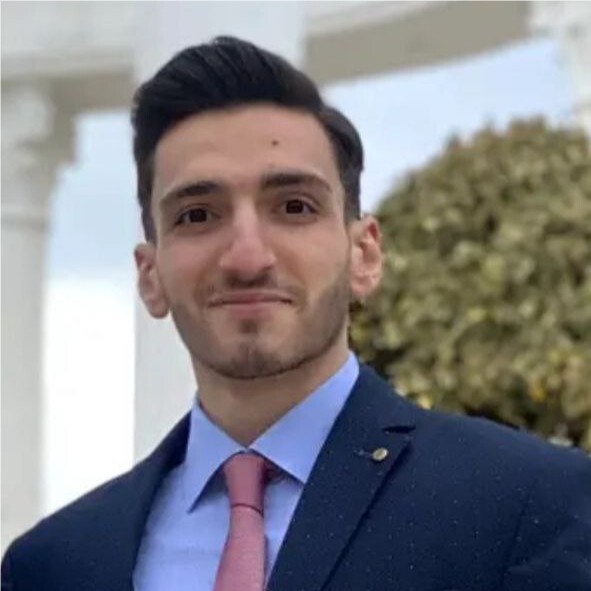
Portrait of Arman Hosseini

PhD Candidate · Systems & Information Engineering

Arman
Hosseini.

I build AI systems that detect when humans are about to make dangerous decisions, using real-time multimodal sensing of gaze and physiological signals, with applications to any safety-critical human-machine interface.

Institution
University of Virginia
Lab
ORCL · Omni Reality & Cognition
Advisor
Dr. Arsalan Heydarian
Scroll to enter

[ 01 ] Research

Projects

Immersive simulators, sensing pipelines and AI models that see risk coming in time to act on it.

3-DOF motion platform
Active · 2026 →

NSF adolescent micromobility safety

An immersive VR e-scooter simulator on a 3-DOF motion platform, with road-surface variation, vibration and physical feedback. Multimodal AI predicts risk for adolescent riders.

NSF CPS-CIR #2553776
  • VR simulator
  • Motion platform
  • Haptics
  • Multimodal AI
Field study

Naturalistic e-scooter riding studies

Real-world e-scooter rides recorded through eye-tracking smart glasses. Gaze is fused with YOLO object detection and distance estimates, head movement and ambient noise to show what riders attend to in live traffic.

ICTD 2025ASCE i3CE 2024
  • Eye-tracking glasses
  • YOLO
  • Areas of interest
  • Naturalistic data
Mixed reality · Vision Pro
Active · 2026 →

VR training for highway maintenance

Immersive VR environments and Apple Vision Pro mixed-reality applications that train highway maintenance workers to stay safe in live work zones.

VDOT
  • Unity
  • Apple Vision Pro
  • Mixed reality
  • Worker safety
2024 – 2026

Roundabout design evaluation in VR

VR bicycle and pedestrian simulations of the proposed Lee Highway roundabout in Bristol, used by VDOT engineers at design review and by residents at a public meeting, with eye tracking showing how each group read the design. Behavioral risk analysis feeds an LLM reasoning layer for explainable design evaluation.

VDOTVTRC
  • Unity
  • Eye tracking
  • Public engagement
  • LLMs
Completed · 2023 – 2024

Water Street VR bicycle simulator

A one-to-one VR model of Water Street in Charlottesville with two hypothetical roundabouts and three bike lane designs, live traffic and pedestrians, and an operator console for running bicycle–vehicle interaction studies.

FHWALeidos
  • Unity 3D
  • Digital twin
  • Bike–vehicle interaction
  • Traffic simulation

[ 02 ] Publications

Papers

Journal articles, conference papers and work in progress. Full list on Google Scholar.

60Citations 5h-index 1i10 Scholar · Oct 2026 ↗

Journal articles 2

  1. 2026
    The Use of Immersive Virtual Technologies for Public Engagement: State-of-Practice Review of US State Departments of Transportation

    C. de Cárdenas, A. Hosseini, E. O’Connor, A. Heydarian, T. D. Chen

    Transportation Research Record

    Published
  2. 2025
    What Affects Pedestrian Street Crossing Decisions in Day and Night Scenarios? A Case Study in Charlottesville, Virginia

    A. Raida, A. Hosseini, C. de Cárdenas, A. Mondschein, A. Heydarian, et al.

    Transportation Research Part F: Traffic Psychology and Behaviour, 115, 103362

    Published

Under review and in preparation 6

  1. 2026
    RIDER: Rider-State-Informed Detection of Emerging Risk

    A. Hosseini, et al.

    ACM CHI 2027 · Full paper

    Under review
  2. 2026
    Cyclist Safety in Right-Hook Conflicts: A Virtual Reality Study

    A. Hosseini, et al.

    Accident Analysis & Prevention

    Under review
  3. 2026
    Impact of Intersection Design and Lighting on Pedestrian Crossing Behavior

    A. Hosseini, et al.

    Transportation Research Part F

    Under review
  4. 2026
    Safety-Reliability and E-Scooter Intelligent Safety Assistance

    A. Hosseini, et al.

    Transportation Research Part F

    Under review
  5. 2026
    From Risk Prediction to Rider Warning

    A. Hosseini, et al.

    IEEE Transactions on Intelligent Transportation Systems

    In prep · Fall 2026
  6. 2026
    Naturalistic Validation of a 3-DOF E-Scooter Simulator

    A. Hosseini, et al.

    Transportation Research Part C

    In prep · Fall 2026

Conference papers 6

  1. 2025
    Real-Time Roadway Obstacle Detection for Electric Scooters Using Deep Learning and Multi-Sensor Fusion

    Z. Zheng, A. Hosseini, D. Chen, O. Shoghli, A. Heydarian

    International Conference on Transportation and Development (ICTD) 2025

    Published
  2. 2025
    Impact of Road Infrastructure and Traffic Scenarios on E-Scooterists’ Riding and Gaze Behavior

    D. Chen, A. Hosseini, A. Smith, Z. Zheng, D. Xiang, A. Heydarian, O. Shoghli, et al.

    International Conference on Transportation and Development (ICTD) 2025, pp. 373–383

    Published
  3. 2024
    Performance Evaluation of Real-Time Object Detection for Electric Scooters

    D. Chen, A. Hosseini, A. Smith, A. F. Nikkhah, A. Heydarian, O. Shoghli, et al.

    ASCE International Conference on Computing in Civil Engineering 2024

    Published
  4. 2024
    Integrated Dynamic Flexible Job Shop and AIV Scheduling: Deep Reinforcement Learning Approach Considering AIV Charging and Capacity Constraints

    A. Hosseini, M. Feizabadi, Z. Yahouni

    IFIP Advances in Production Management Systems (APMS) 2024 · Springer

    Published
  5. 2024
    Multi-Agent Deep Q-Network with Layer-based Communication Channel for Autonomous Internal Logistics Vehicle Scheduling in Smart Manufacturing

    M. Feizabadi, A. Hosseini, Z. Yahouni

    Innovative Intelligent Industrial Production and Logistics (IN4PL) 2024 · Springer

    Published
  6. 2023
    Scheduling AIV Transporter Using Simulation-Based Supervised Learning: A Case Study on a Dynamic Job-Shop with Three Workstations

    A. Hosseini, Z. Yahouni, S. M. G. Feizabadi

    22nd IFAC World Congress 2023 · Elsevier

    Published

Preprints 1

  1. 2025
    Adoption of AI-Assisted E-Scooters: The Role of Perceived Trust, Safety, and Demographic Drivers

    A. Kumar, A. Hosseini, A. Azarbayjani, A. Heydarian, O. Shoghli

    arXiv:2502.05117

    Preprint

[ 03 ] Curriculum vitae

CV

Download full CV ↓

Education

  1. 2023 → present

    PhD, Systems Engineering

    University of Virginia · GPA 3.95

    DissertationMultimodal prediction of cyclist risk behavior using gaze, physiological sensing and immersive virtual reality. Advisor: Dr. Arsalan Heydarian.

  2. 2022

    MSc, Industrial Engineering

    University of Grenoble Alpes, France · GPA 3.67

  3. 2020

    BSc, Industrial Engineering

    Babol Noshirvani University of Technology, Iran · GPA 3.87

Research funding

  • NSF
    CPS-CIR #2553776Adolescent micromobility safety · 2026 →
  • VDOT
    Virginia Department of TransportationTwo projects · 2024 →
  • FHWA
    Leidos and Federal Highway AdministrationWater Street simulator · 2023 – 2024

Awards

  • $1,500
    UVA SIE Student Travel FellowshipTRB Annual Meeting · 2026
  • €5,000
    IDEX Merit ScholarshipGrenoble INP · 2021
  • €8,000
    IDEX Merit ScholarshipGrenoble INP · 2020

Technical skills

AI and ML

  • Transformers
  • LLMs
  • DQN / MARL
  • YOLO
  • PyTorch
  • TensorFlow
  • Scikit-learn

Simulation and VR

  • Unity 3D (C#)
  • Hardware-in-the-loop
  • 3D urban modeling
  • SUMO / Vissim
  • Apple Vision Pro

Sensing

  • Tobii
  • Pupil Labs
  • EDA
  • HR / HRV
  • Multimodal signal processing

Programming

  • Python (advanced)
  • MATLAB
  • R
  • SQL
  • Git
  • LaTeX
  • Linux
  • Docker

Mentorship and service

11students mentored
4 graduate · 7 undergraduate
4mentees became
co-authors
5disciplines
across mentees
21manuscripts
peer-reviewed

Leadership

Graduate Research Operations Lead, ORCL Lab, UVA · 2024 →

Peer review

Transportation Research Record (7) · TRB Annual Meeting (6) · BTR (4) · ASCE (3) · IFAC (1)

Outreach

UVA Link Lab Research Day demos (2023 – 2026) · M Cubed Academy high school mentorship

[ 04 ] Updates

News

In the news · UVA Link Lab Research Day

2026Walking visitors through the VR bike simulator at Link Lab Research Day.
2024Sharing my research on the ORCL VR bike simulator at the Research Day Industry–Graduate Student Reception.
2023Demonstrating the VR bike simulator at Link Lab Research Day.
event.log latest first

2026

  1. Paper

    RIDER paper submitted to ACM CHI 2027 as a full paper.

    →
  2. Grant

    NSF CPS grant awarded for adolescent micromobility safety (#2553776).

    ↗
  3. Paper

    Paper on immersive virtual technologies for public engagement published in Transportation Research Record.

    ↗
  4. Talk

    Presented at the TRB Annual Meeting, Washington, D.C., with a UVA SIE travel fellowship.

2025

  1. Poster

    Poster at ICTD 2025, Glendale, Arizona.

  2. Paper

    Pedestrian crossing decisions paper published in Transportation Research Part F.

    ↗

2024

  1. Talk

    Talk at ASCE Computing in Civil Engineering, Pittsburgh.

[ 05 ] Teaching

Teaching

Supporting courses across three countries, from immersive world-building to AI for decision making.

CE 4500Spring 2026

World Building with VR/AR

Instructional Support

University of Virginia

AI · MLFall and Spring 2021

AI and ML for Decision Aiding

Instructional Support

Grenoble INP, France

IEFall 2019

Inventory Control and Planning

Teaching Assistant

Babol Noshirvani University of Technology, Iran

[ 06 ] Contact

Let’s build safer human–machine systems.

I’m open to research collaborations, talks and conversations about multimodal sensing, immersive simulation and human-centered AI for safety.

Charlottesville, VA · ORCL Lab, University of Virginia

Demo · naturalistic e-scooter study

A real ride, through the rider’s eyes

A real-world e-scooter ride recorded through eye-tracking smart glasses.

Visual attention

The pink circle marks where the rider is looking. YOLO boxes identify nearby moving and stationary objects, each with an estimated distance.

Head movement

The avatar in the upper right mirrors the rider’s head movements, and the label above it names the object being fixated on.

Environment

An indicator next to the avatar tracks ambient noise, so attention can be read against the surrounding environment.

Related paper
Impact of road infrastructure and traffic scenarios on e-scooterists’ riding and gaze behavior, ICTD 2025 ↗
Related paper
Performance evaluation of real-time object detection for electric scooters, ASCE Computing in Civil Engineering 2024 ↗

In the news · UVA Link Lab

Research Day demos

Case study · FHWA · Leidos · 2023 – 2024

Water Street VR bicycle simulator

1:1model of the Water Street corridor
2roundabout designs, suburban and urban
3bike lane treatments
6pilot riders, VR and on-road

Why

Bicyclist deaths in the US reached 938 in 2020 while ridership kept growing. Roundabouts with bike lanes are still rare in the US, so there’s little evidence on how their design affects riders. VR lets agencies test designs that don’t exist yet, safely.

What I built

  • A one-to-one Unity model built from City of Charlottesville drawings and field measurements
  • Two single-lane roundabouts designed to MUTCD guidance, with three bike lane treatments
  • Live traffic, pedestrians and signals, plus a scripted conflict-vehicle scenario
  • An operator console and logging of rider position, speed, head and eye data

Pilot study

Six participants rode the VR simulator and then the real corridor, in a within-subjects design. Their gaze, heart rate and head movement were recorded in both settings to compare virtual and real riding.

My role
Simulation specialist, UVA team
Partners
FHWA Turner-Fairbank Highway Research Center · Leidos · University of Virginia
Stack
  • Unity 3D (C#)
  • SteamVR
  • HTC Vive Pro Eye
  • Wahoo Kickr
  • HoloLens 2

Case study · VDOT · VTRC · 2024 – 2026

VR for roundabout design review and public engagement

▶ 2 videos

▶ Watch the simulations

12VDOT staff tried the simulators at design review
8residents surveyed at the public meeting
14state DOTs in the national survey
6 / 8residents felt little or no motion sickness

Why

2D plan sheets make it hard for engineers and residents alike to picture a new roundabout. Agencies are starting to use VR, but there’s little guidance on how to run it or measure whether it helps.

What we did

  • Reviewed the state of practice through a national survey and interviews with DOTs and consultants
  • Built VR bike and pedestrian simulations of the proposed Lee Highway roundabout in Bristol
  • Ran them at VDOT’s 30% design review and at the public involvement meeting
  • Recorded eye tracking in the headset and analysed fixations and gaze entropy

What we found

Residents said VR let them look around freely instead of from one fixed view, and helped them understand how traffic flows through the roundabout and how crosswalks with splitter islands work. Engineers scanned more design elements than the public, and travel mode shaped gaze patterns more than stakeholder group.

My role
Graduate research assistant: simulation development and gaze analysis
Team
C. de Cárdenas, A. Hosseini, A. Heydarian, T. D. Chen · Virginia Transportation Research Council
Related paper
State-of-practice review, Transportation Research Record (2026) ↗